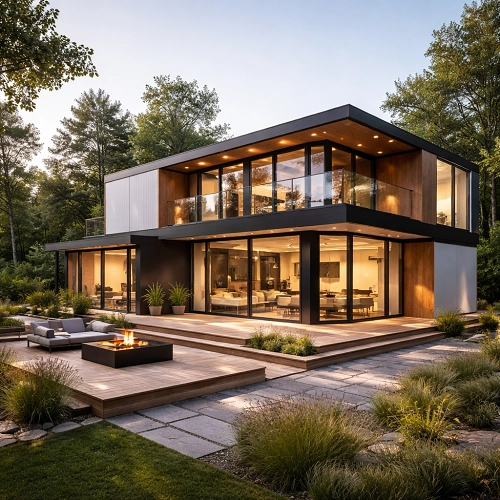
Modern modular housing has emerged as a transformative force in architecture and construction, offering innovative solutions to the challenges of affordability, speed of delivery, sustainability, and design flexibility.
Modern modular houses are residential structures built in sections—modules—manufactured off-site in a controlled factory environment. These modules are then transported to the construction site and assembled into a complete dwelling. Unlike traditional on-site construction, modular building emphasizes precision fabrication, repeatability, and reduced construction time.
Factory Precision: Modules are constructed in controlled environments using standardized processes and quality checks.
Off-Site Fabrication: Major building components and systems are prepared before delivery.
On-Site Assembly: Modules are connected, aligned, and finished on the building site.
Design Flexibility: Modular architecture supports a wide range of styles—from minimalist modern to traditional vernacular designs.
The concept of modular construction isn’t new; it dates back to early 20th-century prefabrication experiments. However, modern modular houses distinguish themselves through advancements in materials, digital design tools, and highly efficient manufacturing practices.
Early Prefab Housing: Utilitarian designs focused on rapid deployment with limited customization.
Post-War Expansion: Prefabrication addressed housing shortages after World War II.
Contemporary Modular Design: Integrates aesthetics, performance engineering, and sustainable systems.
Understanding the technical underpinnings of modular construction reveals why this approach is increasingly preferred. Below are the most significant aspects:
Modern modular design starts with Building Information Modeling (BIM) and parametric design software, enabling precise planning of every element.
BIM Integration: Comprehensive digital modelling of structural, mechanical, electrical, and plumbing systems.
Modular Coordination: Design modules are created with standardized dimensions to facilitate manufacturing and transport.
Advantages:
Reduces errors and rework.
Enables real-time collaboration across disciplines.
Improves accuracy in estimating material use and cost.
Modular houses use a range of materials optimized for factory assembly and performance:
Lightweight Steel Frames: Provide strength and consistency.
Engineered Wood Products: Such as cross-laminated timber (CLT) for sustainability and structural efficiency.
Advanced Insulation Systems: R-value audited to enhance thermal performance.
The structural design must account for transportation and lifting loads:
Lifting Points: Integrated into modules to allow safe crane handling.
Inter-Module Connections: Engineered joints that ensure structural continuity and airtight seals.
MEP systems are often pre-assembled within modules to minimize on-site labor.
Pre-Plumbed Modules: Water and waste lines are installed in controlled factory settings, reducing risk of leaks.
Pre-Wired Electrical Systems: With labeled circuits and safe terminations.
HVAC Integration: Ductwork and systems are frequently installed within modules for consistent quality.
This pre-integration improves:
Quality control.
Construction schedule reliability.
On-site safety.
Transporting modules from factory to site involves careful planning:
Route Surveys: Evaluate clearances and weight limits.
Specialized Trailers and Escorts: Ensure safe transport.
Site Preparation: Foundations, utilities, and cranes must be ready before delivery.
Once on site:
Module Placement: Crane-lifted onto foundation.
Alignment and Connections: Mechanical, electrical, and structural connections completed.
Weatherproofing and Finishing: Exterior sealing and interior finishing to complete the home.
Factory production allows for robust quality management:
ISO Standard Processes: Many factories adopt ISO 9001 quality control systems.
Inspect-At-Each-Stage: Structural, electrical, plumbing, and insulation checks.
Modular homes can be completed 30–50% faster than traditional builds because site work and module fabrication happen concurrently.
Bulk procurement, reduced labor costs, and factory material savings often lead to lower overall project costs.
Controlled factory environments minimize weather delays and errors, leading to consistent build quality.
Modular homes generate less waste and often have improved energy performance.
Sustainability is a core advantage of modular construction:
Pre-Cut Materials: Reduced waste compared with on-site cutting.
Recyclable Components: Steel and engineered wood often have lower environmental footprints.
High Insulation Levels: Enhanced thermal performance for lower energy use.
Air Sealing: Factory precision ensures fewer drafts and energy loss.
Factories implement waste capture and recycling systems that significantly reduce landfill contributions.
While modular housing has many benefits, there are challenges:
Oversized modules may face logistical hurdles related to road and bridge limits.
Some buyers and lenders may mistakenly equate modular homes with low quality, affecting market acceptance and financing.
Complex site conditions (e.g., steep slopes) may require custom solutions.
Several trends are shaping the future of modular design:
Integration of IoT systems, air quality management, and smart energy controls.
Advances in digital fabrication allow for unique designs at scale.
Expanding from single homes to multi-unit developments and mixed-use buildings.
Modern modular houses represent a holistic rethinking of how residential buildings are designed, manufactured, and assembled. Through integration of digital tools, precision fabrication, sustainable materials, and innovative logistics, modular housing is revolutionizing the construction industry—making homes faster, greener, and more customizable than ever before. As technology advances and perceptions evolve, modular homes are poised to become a cornerstone of future housing solutions.